Online Physics lessons · IGCSE · GCSE · A-Level · IB Diploma
First it makes sense. Then the grade follows.
I have taught Physics for thirteen years, to students in Greece and abroad. Small groups, a fixed slot every week, and a written report each month on where your child stands.
Fifteen minutes, no charge. You tell me what your child is finding difficult, ask me anything, and I tell you how I would work with them.

How I see it
Physics is not a memorisation subject
Most students do not struggle with Physics because they are not working. They struggle because something further back never quite settled, and from then on every new topic is built on top of it.
The subject starts to look like a collection of unrelated formulas you have to remember. In reality Physics is a small number of ideas that keep coming back, wearing a different face each time.
My job is to make that visible. Once a student sees how the pieces connect, they stop memorising and start thinking. And exam questions stop being a surprise.
This is how I explain it
An example of the kind of thing we talk about in a lesson.
You are holding your phone. You are not touching it.
The atoms in your hand never actually come into contact with the atoms in your phone, the way two small spheres would. Around every atom there is a cloud of electrons, and as they approach, those clouds interact and push back.
What you feel as "I am holding my phone" is exactly that resistance. And what we call the normal force at school, and draw as a single arrow, has both electromagnetism and quantum mechanics hiding behind it.
You do not need any of this to solve the question. But once you have seen it, the arrow stops being a symbol you memorise.
The programme
It rests on four things
None of them is impressive on its own. Together they change the way a student works through the year.
Up to four students, at the same level and on the same syllabus. There is time for each of them to ask, and to ask again if it did not land the first time.
We know from the start what we are covering each week and how it connects to what came before. The syllabus never arrives as a surprise, for your child or for you.
If they get stuck on a question one evening, they send a photo and get a written answer back. They are not waiting for the next lesson to get unstuck.
Marked tests and a written report every month. You know what we covered, where they stand and what comes next, without having to ask your teenager.
How we start
Four steps
From your first message to the first lesson is usually about a week.
-
Step 1
Fifteen minutes together
You pick a time that suits you. You tell me where your child is struggling, ask me anything, and I tell you whether and how I can help.
-
Step 2
A diagnostic with your child
Half an hour with them, no charge, so I can see where we are starting from and which group fits.
-
Step 3
I write to you
One page within 48 hours: what is missing, what I recommend and which slot. You decide with a clear picture.
-
Step 4
Lessons begin
A fixed weekly slot, with students at the same level.
Programmes and fees
Choose a programme
A monthly fee, in a group of up to four students. There are also one-to-one lessons and intensive courses during the holidays.
IB Physics
DP1 and DP2, Standard and Higher Level.
A-Level and AS-Level
Cambridge and Edexcel.
IGCSE and GCSE
Year 11, Cambridge and Edexcel.
Year 10 and Pre-IB
For students joining the programme next year.
For Greek families abroad whose children follow the Greek national curriculum and will sit the Panhellenic examinations.
Year 12 (Γ΄ Λυκείου)
Physics for the Panhellenic examinations.
Year 11 (Β΄ Λυκείου)
Both streams, in the same hours.
Year 10 (Α΄ Λυκείου)
Builds the base needed in the two years that follow.
The full Greek-language page is here: Φυσική Γραμμένος.
One-to-one lessons
Introductory rates, for as long as there are hours left in my timetable. Anyone who starts at this rate keeps it for as long as they continue.
Intensives and seasonal courses
What is included
Three levels, depending on how much support is needed
All three run in a group of up to four students. What changes is the hours, the number of tests and how much one-to-one time is included.
Monthly programmes, in a group of up to four students
| CORE | FULL | INTENSIVE | |
|---|---|---|---|
| Teaching in the group | ✓ | ✓ | ✓ |
| Problem-solving lab | — | ✓ | ✓ |
| One-to-one time | — | 1 hour a month | 30 minutes every week |
| Marked tests | 4 a year | 8 a year | 8, with error analysis |
| Questions between lessons | at the next lesson | in writing | in writing, prioritised |
| Written monthly report | ✓ | ✓ | ✓ |
| Bank of worked solutions | ✓ | ✓ | ✓ |
| Full mock papers | — | 2 a year | 4 a year |
This is how I explain it
Metal is not colder than wood
Put one hand on a wooden surface and the other on a metal one. The metal feels colder. But if they have been in the same room for a while, they are at exactly the same temperature.
What changes is how quickly heat leaves your hand and moves into each material. Metal is a far better conductor, so it draws heat away faster, and that speed is what gives you the sensation of cold.
Your hand is not a thermometer. If the metal and the wood were both warmer than you, which one do you think would feel hotter?
Who I am
Greg Grammenos
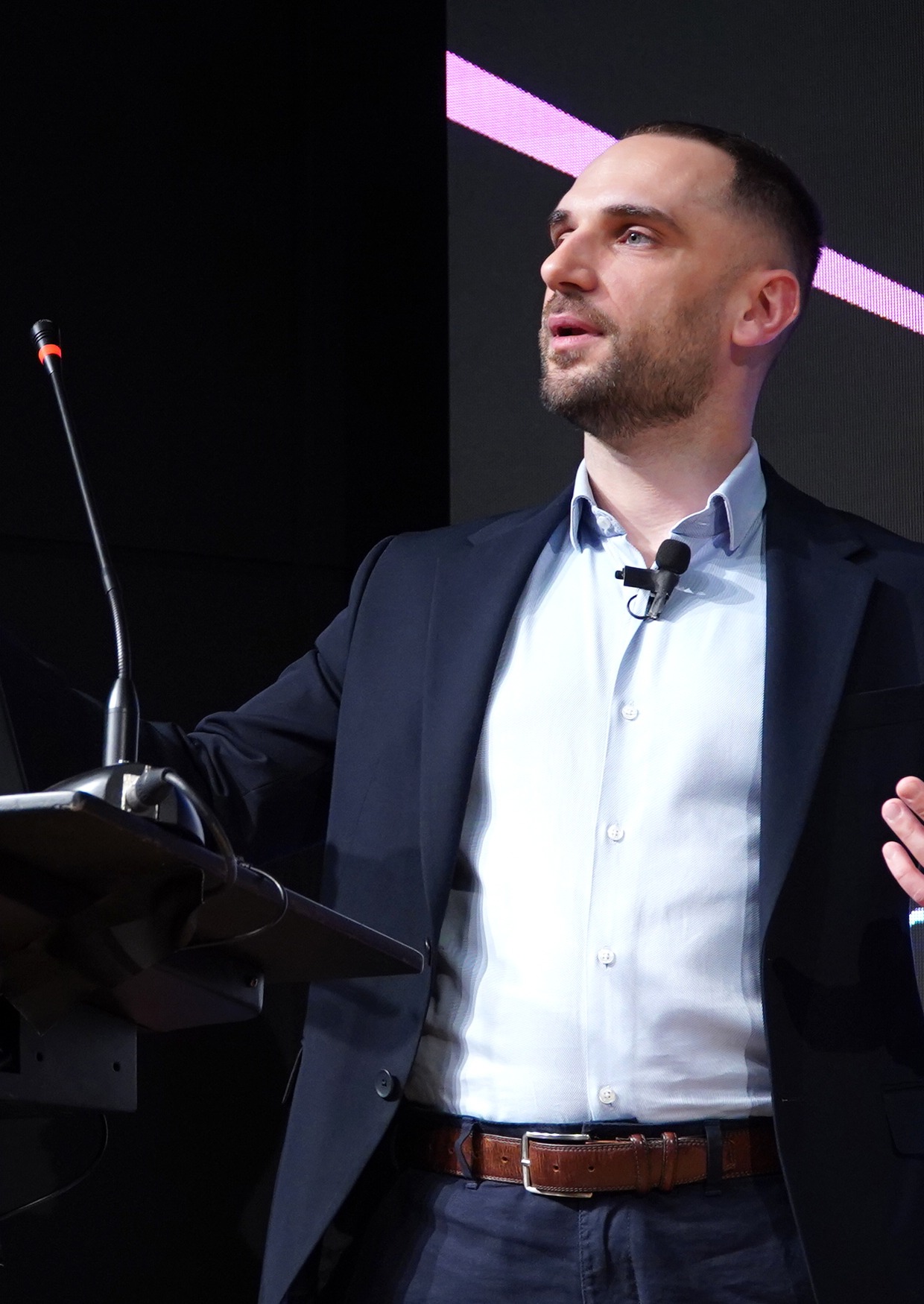
I am a physicist and I have been teaching Physics for thirteen years, to students in Greece and abroad. For the last six years the lessons have been entirely online.
What I like about Physics is that it explains the world around us using only a handful of ideas that turn up everywhere. The same law that makes an apple fall keeps the Moon in orbit. Once a student sees that, their relationship with the subject changes.
So in every lesson I try to get them to understand what is happening first, and reach for the formula second. A formula you remember without understanding is the first one that will let you down in an exam.
- 2011 Physics teacher, across the Greek curriculum and international programmes.
- 2022 Module Leader and Course Instructor at BCA College, in partnership with the University of West London.
- 2018–2022 Scientific consultant and conference producer at Boussias.
- Based in Athens, Greece.
What families say
From students and parents I have worked with
At the start of my A-Levels I was struggling to grasp the basic concepts of Physics. Grigoris helped me break the problems down and understand them in a way I could process. I went from very poor grades to excelling in my class by the end of the year, which landed me a place studying Aerospace Engineering at Swansea University.ConnorA-Level, now reading Aerospace Engineering
A very engaging teacher with a personalised approach. He immediately captured the interest and attention of my 13-year-old son. Equally important, he has a strong understanding of the IB curriculum and its teaching methodology across different levels.E. T.Parent, IB student
Highly knowledgeable and experienced in Physics, with a deep understanding of how to teach it. He immediately gained both our trust and our son's. He focused on his individual needs and learning difficulties and was always well prepared. Our son's performance improved and his interest in Physics grew significantly.S. M.Parent, secondary student
An excellent teacher and a wonderful person, always very responsive. He started working with my son during his first year of secondary school. An experienced teacher with an approach that makes lessons both easy to understand and enjoyable.M. M.Parent
Questions
Frequently asked
How does an online lesson actually work?
On a digital whiteboard with a stylus. Your child watches every step of the solution being written in front of them, just as they would on a classroom board, and everything stays saved so they can go back over it whenever they want. You also save the travelling time.
How many students are in a group?
Four at most, at the same level and on the same syllabus. The fee is the same whatever the final size of the group turns out to be.
How does the time difference work?
I teach from Athens in the late afternoon and evening. For families in the Gulf that is one to two hours ahead of me, so a lesson lands in your child's evening and in mine. For families in the UK it is the other way round and there is still plenty of overlap. We agree the slot before anything starts.
Which exam board do you follow?
Whichever one your child's school sits. Tell me the board and the level at the first call, and the plan is written against that specification rather than a generic one.
Can my child start part-way through the year?
Yes. The diagnostic shows me where they are and which group is the right fit, or we start a new one. There is no need to wait for September.
What equipment do they need?
A computer or tablet with a camera and a stable connection, headphones and a notebook. Quite a few students join from their phone and it works fine. The lesson opens from a link, with nothing to install.
What is the "problem-solving lab"?
It is the hour where the group works through questions from their own syllabus together, with me alongside. It is not practical work with apparatus. For the IB we cover the Internal Assessment separately: design, data, uncertainties and analysis.
How do I pay from outside Greece?
Monthly, at the start of each month, by international bank transfer, Revolut or Wise, in euro, with an invoice each time. If another arrangement suits you better, tell me and we will sort it out.
What if we are not a good fit?
That is what the diagnostic is for: half an hour with your child, no charge, before anyone decides anything. If I think I am not the right person I will say so, and tell you what to look for instead. And if we start and it is not working, tell me and we stop.
Do you teach the Greek national curriculum?
Yes, including for the Panhellenic examinations. The full Greek-language page is here: Φυσική Γραμμένος.
We start with fifteen minutes
Pick a time that suits you. You tell me where your child is struggling, ask me anything, and if it looks like I can help we arrange the half-hour diagnostic with them, at no charge.
Pick a time
Fifteen minutes, no charge. This opens my calendar with the slots that are free.
Book a 15-minute chatOr leave your details and I will get in touch.